
Reimagining Menstrual Health for a Climate Resilient Future
Climate change and menstrual health supply chains are inextricably linked. Menstrual supply production and waste contribute to greenhouse gas emissions, while climate-related disasters threaten product supply chains and affordable, equitable access. Across the value chain, all actors have a role in addressing the links between menstrual health and climate change, while ensuring that everyone who menstruates has access to the products they need.
The Reproductive Health Supplies Coalition (RHSC), in partnership with the Climate Communications Collective, has developed practical resources, informed by experts,to promote tangible actionable recommendations to address the impacts of menstrual health supply chains and climate change.
→ Explore the Report
→ Access the Database (coming soon)

Why this matters
There are an estimated 1.72 billion people who menstruate living in low-and middle-income countries.
- An estimated 93% who use purpose-made products are using single-use products,
- Which contributes 250,000 tons of carbon dioxide annually – equivalent to 58,314 gas-powered vehicles.
- Simultaneously, climate-related disasters disrupt menstrual product supply chains, leaving end users without access to critical reproductive health supplies
There is a need to understand the links between menstrual product supply chains and climate change. And importantly, the responsibility for addressing these challenges should not fall on the needs of people who menstruate, but rather, through more coordinated collective action across the menstrual health product space.

The Data & Research Gap
To date, limited information is available on the impact of menstrual products on climate change--and the extent to which climate-related disasters disrupt product access.
This creates:
- A lack of clarity around ‘eco-friendly solutions’
- Assumptions about what ‘eco-friendly products’ look like
- A lack of coordinated action in addressing these impacts
Evidence-based, actionable advocacy recommendations are critically needed.

Driving Collective Action
Creating change is possible, but it will require greater collaboration and coordination.
Critical pathways include:
- Stakeholder collaboration and participation across the product’s entire life cycle
- Stronger global policies
- Understanding the bi-directional relationship between menstrual health and climate change
Across all pathways, people who menstruate—and their needs—must be at the center.
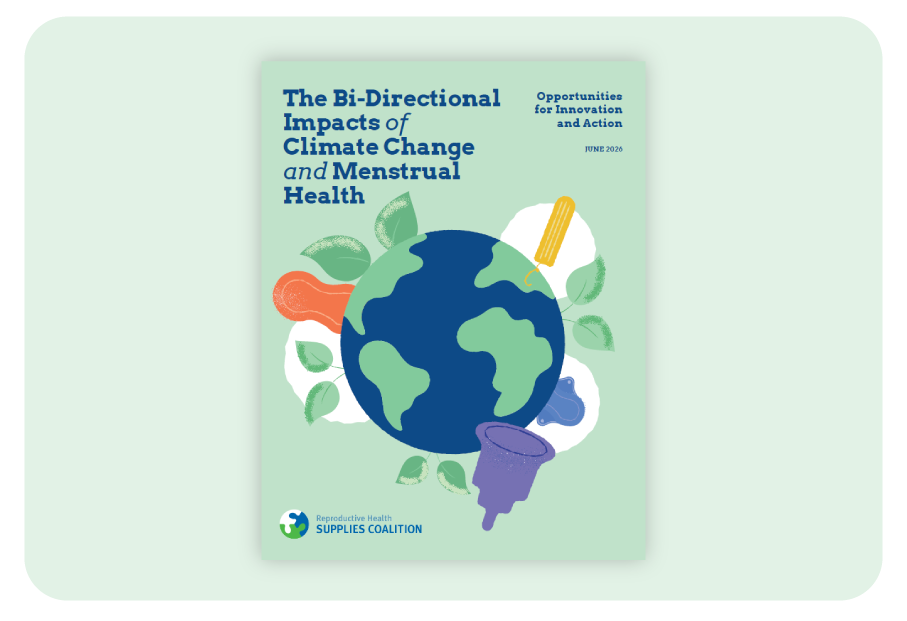
The Bi-Directional Impacts of Climate Change and Menstrual Health: Opportunities for Innovation and Action
Menstrual health and climate change are more connected than many people realize and one thing is clear: there’s no single solution—and no single actor who can solve this alone.
In this report we cover:
- Where emissions really happen
- How products compare, and why there’s no silver bullet
- Why climate resilience belongs in menstrual health supply chains
Recommendations for policy leaders, researchers, and academic institutions, and more.
Social Media-Based Advocacy Assets
The first step in addressing the impacts of menstrual health and climate change is awareness. You can help stakeholders learn how they can transform menstrual product supply chains. Help disseminate our report and spread awareness on social media using the assets below.
Download the Social Media Assets (Zip File)

Climate Change and Menstrual Health Partners Database (coming soon)
The Climate Change and Menstrual Health Partners Database will serve as a centralized directory of stakeholders working at the intersection of climate change and menstrual health.
Its core objectives are to:
- Strengthen collaboration across geographies, stakeholder types (e.g., manufacturers, advocates, product designers), and sectors (e.g., WASH, SRHR, gender equity)
- Increase the visibility of innovative products, emerging initiatives, and implementing partners in the climate-menstrual health space
- Enable report readers to identify potential partners, experts, and case studies
The Climate Change and Menstrual Health Partners Database is under development and will be released later this year. We will also share a form for organizations/partners who would like to be included in the database.