Raising the Bar: Global Menstrual Product Standards

Safe, high-quality menstrual products are essential to health, dignity, and participation. Yet millions of people still lack access to products they can trust. Explore tools and data designed to strengthen menstrual product standards globally—and support countries to take action. The Reproductive Health Supplies Coalition (RHSC), in partnership with Menstrual Health Action for Impact (MHAi), has developed practical resources – informed by experts – to support stakeholders in low- and middle-income countries. They support active participation, informed decision-making, and effective
implementation.

Why this matters

Menstrual health is a critical public health, gender equality, and economic issue.

  • 1.72 billion people who menstruate live in low- and middle-income countries
  • This number is projected to reach 1.89 billion by 2035
  • Over one-third are unable to meet their needs with safe, purpose-made products

Many rely on materials like cotton wool, tissue, and old rags -- compromising their health,
dignity, and daily participation.
The Standards Gap

In many countries, menstrual product standards are limited—or do not exist. Where standards do exist, they often vary widely

This creates:

  • Risks for consumers
  • Barriers for manufacturers
  • Fragmented and inefficient markets

Stronger, more harmonized standards are essential.

Global Momentum for Change

The International Organization for Standardization (ISO) is developing global, harmonized standards for menstrual products through ISO TC 338.

These standards will shape how products are:

  • Developed
  • Regulated
  • Distributed

Engagement from low- and middle-income countries is critical to ensure these standards are relevant, equitable, and implementable.
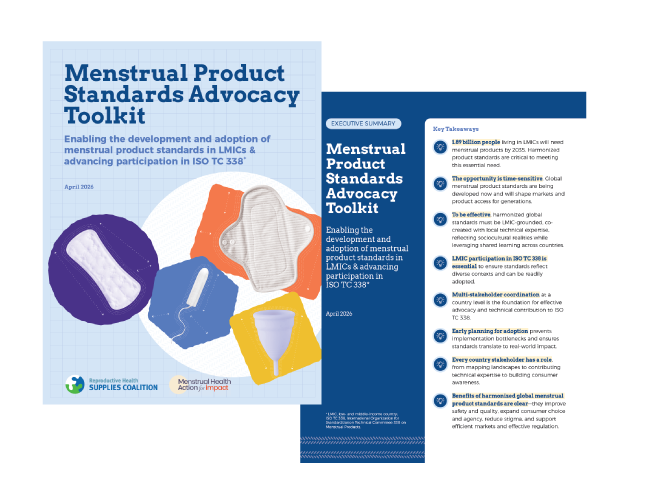
Menstrual Product Standards Advocacy Toolkit

A practical guide to support engagement with standards development, adoption, and rollout at national and global levels.

The kit includes:

  • Full toolkit (available in English, French, Spanish, and Portuguese)
  • Executive summary
  • Practical tools:
  • Advocacy checklist for ISO TC 338 participation
  • Market mapping template
  • National Standards Body engagement checklist
  • Advocacy presentation template

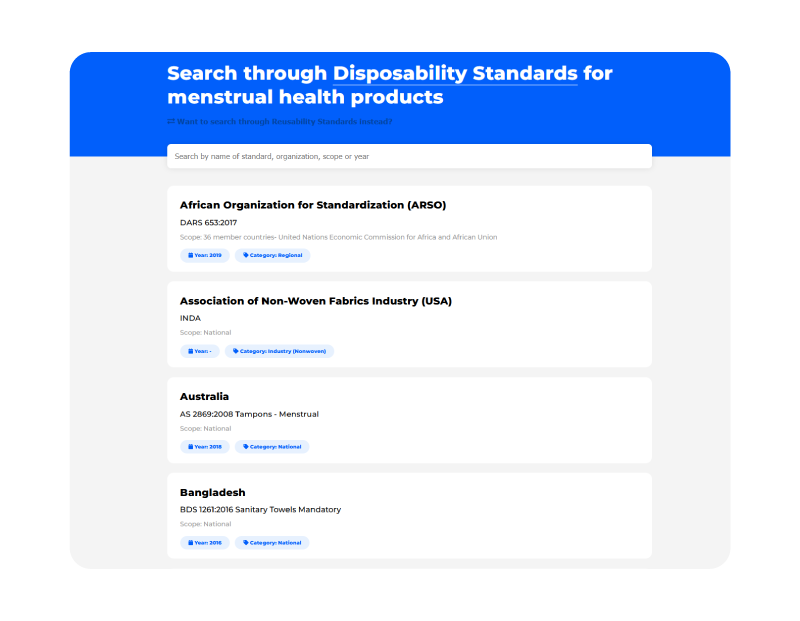
Menstrual Product Standards Database

A comprehensive compilation of menstrual product standards from countries across income groups.

Expanded coverage includes:

  • Menstrual pads (single and multiple use)
  • Tampons
  • Menstrual cups
  • Period underwear
What You Can Do with the Database

The database is designed to support decision-making, advocacy, and research. You can:

  • Compare standards across countries
  • Explore key technical parameters such as safety and performance
  • Analyze regulatory approaches
  • Inform policy, procurement, and program design
What Is Included?

The database brings together:

  • Country-level standards 
  • Regional standards, including those from bodies such as the African Organization for Standardization
  • Institutional standards, including procurement requirements and industry guidelines

For each standard, users can explore:

  • Administrative and regulatory features
  • Performance requirements
  • Safety requirements
  • Other technical specifications

Users can view summaries, dive into detailed records, or compare standards across contexts.

Methodology

The database is compiled using:

  • Information provided by National Standards Bodies
  • Publicly available data from government and trusted online sources

Data reflects information available as of March 2026. As many standards are not publicly accessible, entries include only information that has been approved for sharing. The database will continue to evolve as new standards are developed and existing ones are updated.