
The Affordability Gap: Leveraging Tax Reform to Improve Equitable Access to Menstrual Products
613 million people who menstruate lack sufficient access to menstrual products.
For many, affordability presents a significant barrier to access and drives inequity in who can buy menstrual products and who cannot. Significant strides have been made globally to reduce product prices, including efforts to leverage tax reform to ensure product affordability. Yet, they have often fallen short.The Reproductive Health Supplies Coalition (RHSC), in partnership with Mann Global Health, has developed a suite of resources to better understand opportunities for tax reform – and importantly, the extent to which reform improves product affordability and equitable access.

Why this matters
Despite global efforts to improve menstrual product affordability in low-resource settings, high prices make menstrual products unaffordable for many.
- 1.72 billion people who menstruate live in low- and middle-income countries and 613 million lack sufficient access to purpose-made menstrual products
- Taxes on menstrual products disproportionately affect women, girls, and people who menstruate in LMICs
- Yet most tax reform efforts to date have failed to improve product affordability and equitable access
Improving product affordability requires a better understanding of what costs are driving product price and how tax reform passes savings onto the end user.
The Tax Reform Gap
Globally, across both high-income countries as well as LMICs, significant strides have been made to remove the ‘period tax.’ Yet in many contexts, this tax reform has not resulted in meaningful changes to product affordability and equitable access.
This is because:
- There is often a lack of clarity behind how taxes, duties, regulatory fees, and mark-ups through the supply chain shape price and affordability
- Tax reform does not always result in cost-savings to the end user
- When savings are passed on to the end user, it is not always in an equitable way –affordability for the lowest income populations often doesn’t change.
A better understanding of tax reform – and how costs are passed through the full value chain – is essential for improving product affordability.

Evidence-Based Advocacy
Improving product affordability across LMICs is possible, but it requires evidence-backed, coordinated advocacy. Tax reform requires a nuanced, country-specific approach.
Yet, across geographies, there are four powerful messages for menstrual product tax reform:
- Affordability drives use and directly impacts health outcomes
- Tax policy must be neutral to avoid hidden costs
- Smarter tax design can lower prices and strengthen domestic industry
- Tax reform must be part of a broader market-shaping package
Coordinated action, rooted in country-specific realities is crucial for ensuring that tax reform has meaningful impact on affordability.
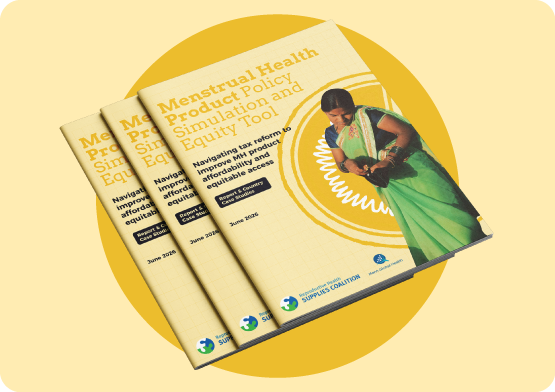
Navigating Tax Reform to Improve Product Affordability and Equitable Access
This work examines how upstream costs - including taxes, duties, regulatory fees, and value chain markups - shape the price and affordability of menstrual health (MH) products. While policy discussions often focus on changes to headline tax rates, consumer prices are ultimately determined by how costs accumulate and are passed through across complex market systems.
Combining a structured analytical framework with applied modeling, this work provides a practical approach for estimating how fiscal and regulatory policies translate into real price and affordability outcomes for consumers. It is designed to support policymakers, advocates, manufacturers, and market actors in identifying key cost drivers, testing policy scenarios, and advancing more effective and equitable MH market strategies.
The work is organized as five integrated components that move from evidence generation to methodology, modeling, country application, and advocacy.
Literature Review and Key Informant Interview Analysis Report
Synthesizes global and country-level evidence on upstream cost drivers, fiscal policy, market structure, and affordability dynamics affecting MH products.
The Literature Review also incorporates insights from key informant interviews with global and country specific stakeholders such as global and domestic manufacturers and marketers, country tax authorities, product innovators, and others representing a variety of perspectives.
Framework, Approach, and Methodology
Introduces the analytical framework, costing methodology, key concepts, data requirements, and step-by-step guidance for applying the approach across different country contexts.
Full Report & Country Applications
Applies the framework and modeling approach in Kenya and India to assess how tax policy, market structure, and implementation dynamics shape affordability, pass-through, and market outcomes in practice. A Generic model is available (above) to apply in other country contexts.
This report serves as the primary point for this work, aggregating findings from across the literature review and KIIs, presenting and explaining the model, and applying it to the two country case studies.
Advocacy and Policy Materials
Translates technical findings into concise advocacy decks, policy messages, and practical recommendations to support evidence-based dialogue and reform efforts with policymakers and stakeholders.
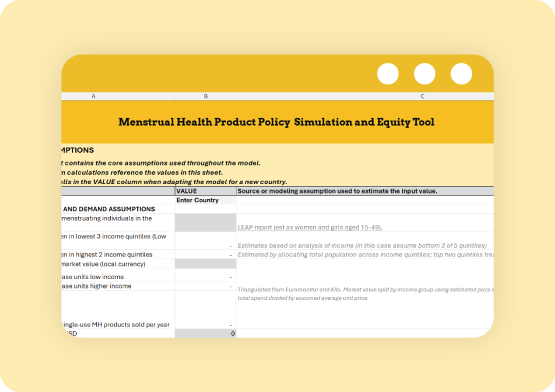
Menstrual Health Product Policy Simulation and Equity Tool
An Excel-based simulation model that quantifies cost build-up across the value chain and tests policy scenarios, including VAT, duties, levies, and regulatory fees to estimate impacts on pricing, pass-through of savings to consumers, affordability, and equity across income groups.
This Excel-based model is intended to be downloaded and adapted to different country contexts. It includes guidance on how to provide the relevant inputs in order to explore different tax reform scenarios and how they will improve product affordability and equitable access. We have also included two populated case studies: one for Kenya and one for India. These case studies will help users understand how to use and apply the model. Please note that the Kenya Case Study is likely the most relevant/replicable for other geographic settings.
COMING SOON: We will have a video tutorial to walk you through how to use the tool and adapt it for your country contexts.